 Digressive Celts
Just Be Good: Why there isn’t a trade-off between the league and Europe for Celtic
Good teams win games, at home and abroad. We checked whether European football costs Celtic anything in the league.
By Larry Nerd
Good teams win games.
However, not all games are the same.
Different teams play in different styles that complement and clash, and some teams have extra games. This means that it’s possible a team could be more suited for some fixtures than others.
This is the apparent motivation behind much of Celtic’s strategy, according to former chief executive Peter Lawwell. Back in 2019, he asked fans:
“Would you take Rangers winning the league for four years to maybe reach a Champions League semi-final?” [1]
This carries the assumption that optimising for either domestic or European football comes at a cost to the other.
We set out to find out if that’s true.
The obvious check is whether teams that do well in Europe also do well domestically.
In a general sense, they do. But that’s because they’re better than most of their peers: to qualify for Europe, they had to put up a respectable league performance the prior season. Compared to the group, they’re obviously good.
However, our question is specifically about the cost at the fine margins. Does it affect their title chances at all? When we only look at good teams, do teams that do well in one tend to do well in the other?
To check this, we first compared teams with themselves. Before every season, we rated each club with our own ratings, which weigh league strength based on matches between clubs from different leagues. That gives us an expectation for every match. If Europe comes at a cost, teams should fall short of that expectation domestically when they play more European football, or European football goes well.
We looked at Scotland and 11 similar leagues from 2002/03 to 2025/26: over 39,000 league games and 8,000 European games involving clubs in Europe. Further details in Appendix A.
Previous work on bigger leagues found little cost [2, 3], but didn’t account for how good the teams were.
The most common argument about European football damaging domestic results is about the congested fixture list. Playing in Europe midweek may fatigue your players, and gives you less time to prepare for the weekend.
To test this, we took every league game within three days of a European game and compared it with the same club’s other league games that season.
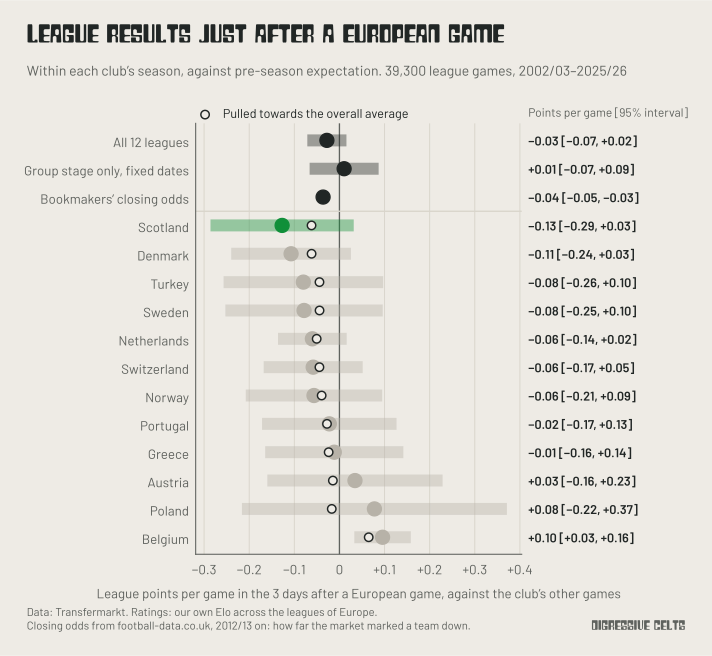
Across the 12 leagues we tested, teams took 0.03 fewer points per game than expected after a European game. That’s approximately one point every 33 post-European games. It is not clearly different from zero, indicated by the confidence interval crossing over zero.
Scotland does look worse on its own. However, that is only 370 games. On such few games, that could be luck. Our best estimate when we blend with other leagues for statistical power is −0.06 (with Scotland’s own figure counting for about a third of the blend). In a season they reach the group stage, Celtic or Rangers play about six league games within three days of a European one, so that’s around 0.4 points per season. Since the league phase format started, it’s been closer to eight, or nearly 0.5.
The bookmakers agree. Their closing odds mark a team down by 0.04 points per game after a European game.
A stronger claim is perhaps that simply being in Europe as a whole comes with a cost. The cumulative effect of extra games, travel, attention, pressure, and whatever else happens when you play in Europe could be damaging to domestic results.
To test that, we needed similar teams where one plays more European football than the other. For this, we used play-offs. When a tie for a place in the group stage went to penalties or came down to a single goal, we made the assumption that which team went through was largely down to luck or very fine-grain differences. Because of this, we could use the loser as a control for the winner. The winners played about five more European games that autumn.
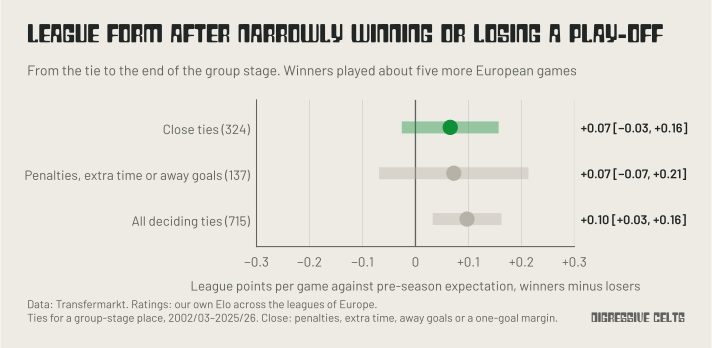
The winners did slightly better in the league. Again, it is not significantly different from zero, and is certainly not a sign of a cost.
If clubs were choosing between Europe and the league, good European seasons should come with poorer league seasons.
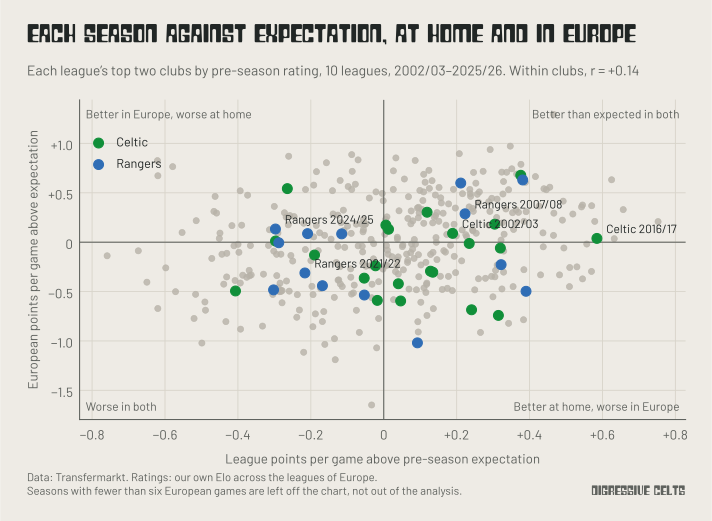
They don’t.
Seasons that go better than expected in Europe tend to go better than expected at home too.
The same goes for the title race.
Between each league’s top two, the side that did better in Europe was, if anything, somewhat more likely to finish above the other.
It is possible that the trade-off could be about how a club is built rather than in any given season. Some squads could be built for Europe rather than the league.
We compared each club with what its squad’s value would predict, at home and in Europe, against other clubs from its own country.
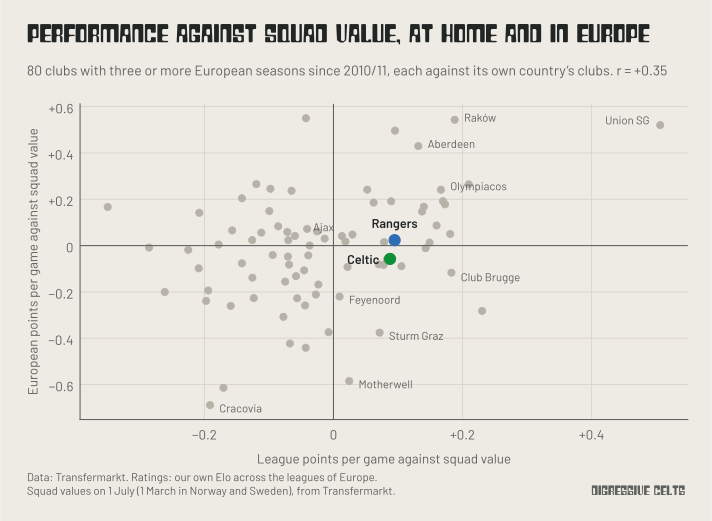
Clubs that performed better than their squad value at home tended to do so in Europe too. Celtic and Rangers were slightly above their squad value at home and about level in Europe.
So, historically, European football has correlated with about a 0.4 point reduction per season in the league. This is not beyond the threshold of noise as its confidence interval does not exclude zero.
However, even if we concede up to a point cost per season, Scottish titles are rarely that tight.
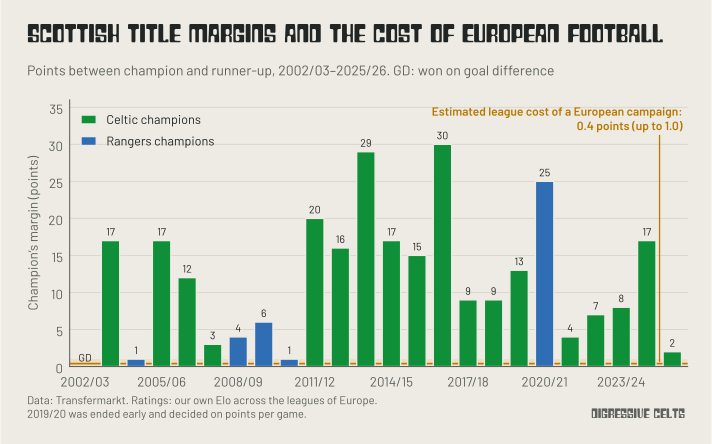
Of the last 24, one was decided on goal difference and two by a single point. In 2002/03, Celtic played 15 European games on the way to the UEFA Cup final and lost the league on goal difference. There has not been another title decided on goal difference since then.
We did find one result that runs contrary to the mostly null findings in the rest of this article.
Clubs that narrowly won a Champions League play-off (and so played in the Champions League rather than the Europa League) did worse in the league the following season.
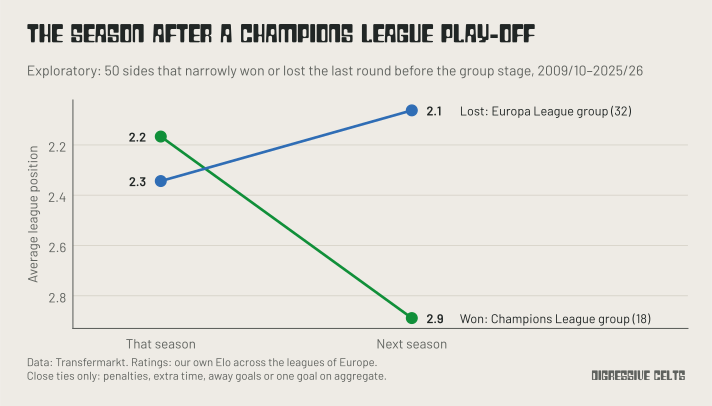
This is only 50 play-off sides and is purely descriptive, conducted post-hoc after our other tests that we had pre-planned.
One reason (if there is an effect and this is not simply noise) could be selling players after a Champions League run and weakening the squad. Another could be their rivals strengthening to try and close the gap.
So, it would appear that good teams do just, simply, win games. There’s no reason to choose: if Celtic want to be good in Europe, there is no evidence that this should come at the cost of their league dominance.
If there is a risk, it seems that it would be how the summer after a Champions League run is managed.
But, for now, our cutting insight is that: if Celtic want to be good in Scotland alongside Europe, they just need to—eh—be good.
References
[1] The Scotsman (2019). Would you take Rangers winning the league for 4 years to maybe reach a Champions League semi? Peter Lawwell on Celtic ambition, Kieran Tierney’s transfer to Arsenal and hotel. The Scotsman. https://www.scotsman.com/sport/football/scottish-premiership/latest-premiership-news/would-you-take-rangers-winning-the-league-for-4-years-to-maybe-reach-a-champions-league-semi-peter-lawwell-on-celtic-ambition-kieran-tierneys-transfer-to-arsenal-and-hotel-and-1401265
[2] Buchheit M, Settembre M, Hader K, Tarascon A, McHugh D, Verheijen R (2022). Do mid-week European matches influence European teams’ performance in their domestic league? A 20-year study. Sport Performance & Science Reports, 175, 1–8. https://sportperfsci.com/do-mid-week-european-matches-influence-european-teams-performance-in-their-domestic-league-a-20-year-study/
[3] Stephens R, Bosworth G, Shepherd TA (2019). Playing in the UEFA Europa League does not adversely affect English Premier League or La Liga performance. Journal of Functional Morphology and Kinesiology, 4(1), 2. https://doi.org/10.3390/jfmk4010002
Appendix A: test details
We took match data since 1995/96 from Transfermarkt and closing odds from football-data.co.uk. The 12 leagues are Scotland, the Netherlands, Portugal, Belgium, Turkey, Greece, Austria, Switzerland, Denmark, Norway, Sweden, and Poland. The tests cover 2002/03 to 2025/26. The seasons before that give the ratings time to settle.
We calculated our own Elo using one scale across every league that has sent a club to Europe. Ratings were frozen before the first game of the season so results over a season couldn’t move the expectation. The top two clubs were picked based on those pre-season ratings.
In Elo, every club has a rating. After each game, the side that did better than the ratings expected takes points from the other: more for a bigger upset, and a little more for a bigger win. European games move points between leagues so all clubs across countries are on the same scale.
Only league and European games count. A European result moves a rating more than a league one. Home advantage is worth 64 rating points in the league and 81 in Europe (about half that with no crowd). We set these to best predict results from 2002/03 onwards.
The gap between two ratings gives each side’s chances of a win, draw, or loss, and so its expected points, from a model fitted to each league’s results.
Where we could check, our ratings rank clubs within each country much as ClubElo’s do (correlations of 0.86 to 0.99).
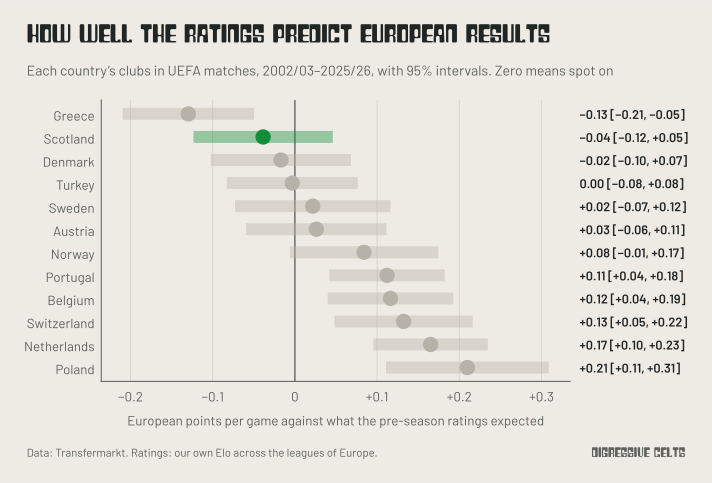
The ratings were well aligned for Scottish clubs in Europe. They had some leagues too high or low, but that cancelled out when a club was compared with itself or within its own league.